Temperature Monitoring Procedure for Warehouse Template
Original price was: ₹499.00.₹249.00Current price is: ₹249.00.
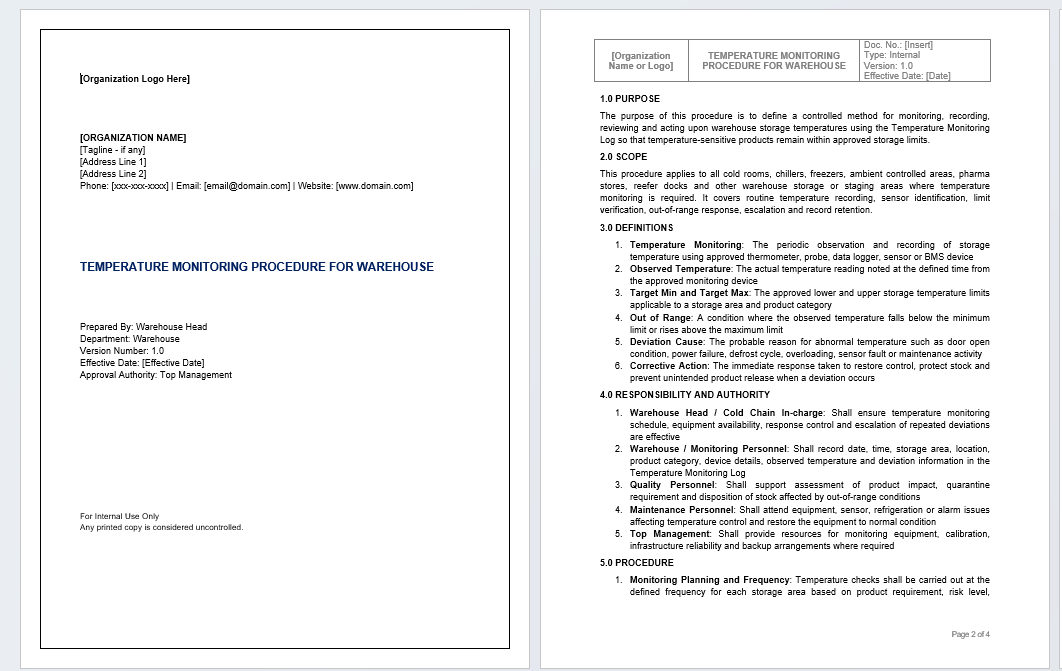
The above image is only a preview. This Temperature Monitoring Procedure for Warehouse Template helps organizations standardize warehouse temperature recording, approved range checks, out-of-range response, stock protection, and record retention. It is useful for cold rooms, chillers, freezers, pharma storage, food warehouses, and other controlled environments that require dependable temperature monitoring documentation.
Description
What is this Temperature Monitoring Procedure for Warehouse Template?
The above image is only a preview. This Temperature Monitoring Procedure for Warehouse Template helps organizations control storage temperatures in areas where product condition depends on defined temperature limits. It explains how readings are taken, how limits are checked, how deviations are handled, and how records are retained. Therefore, it supports product protection and stronger storage compliance.
Moreover, this template is practical for cold chain and controlled storage operations. It covers monitoring frequency, storage area identification, device reference, approved range review, deviation response, product segregation, escalation, and record retention. As a result, teams can follow one consistent method for monitoring temperature-sensitive environments. In addition, it reduces the risk of informal recording and delayed response.
Furthermore, the procedure is linked to the temperature monitoring log. Thus, the written process connects directly with the operational record used on site. Consequently, this template supports real warehouse control rather than generic cold storage language. It is useful for warehouses that need evidence of regular monitoring and a defined response to out-of-range conditions.
Besides that, temperature deviation can affect product quality, shelf life, regulatory compliance, and customer confidence. For that reason, storage temperatures need more than occasional checking. Hence, this template helps organizations formalize temperature control with clear responsibility, better traceability, and improved response discipline.
Who can use this template?
This template is useful for cold storage facilities, pharma warehouses, food and beverage warehouses, chemical stores, reefer dispatch points, distribution centers, healthcare supply warehouses, and any business storing temperature-sensitive stock. Similarly, it suits organizations managing chillers, freezers, cold rooms, or monitored ambient zones. Therefore, it can support many controlled storage applications.
Warehouse heads can use it to define temperature control responsibilities. Monitoring personnel can use it for routine recording. Quality teams can use it for product impact review. Maintenance teams can use it during deviation response and equipment follow-up. Likewise, compliance teams can use it during audit preparation and documentation control.
In addition, this template is useful for ISO systems, quality control programs, warehouse SOP implementation, and training of cold chain staff. Consultants and business owners can also use it to formalize temperature control in professional warehouse documentation. Therefore, it adds value in both operational and compliance settings.
Why is this template useful?
This template adds value because it addresses the full monitoring cycle, not just the act of recording a temperature. It helps define approved ranges, compare readings, capture abnormal causes, assign immediate action, and protect potentially affected stock. As a result, the warehouse gains better control over both data and decision-making.
Moreover, it supports stronger product protection. If temperatures move outside approved limits, delayed action can create serious commercial and quality consequences. Therefore, a clear monitoring procedure improves response speed and helps prevent uncontrolled stock release. Furthermore, it strengthens communication between warehouse, quality, and maintenance functions.
Additionally, the procedure helps management review repeated issues such as door opening, unstable zones, sensor faults, or refrigeration weakness. Consequently, businesses can move from reactive correction to preventive improvement. Also, the editable format helps users customize zones, product categories, device references, and internal escalation rules.
Most importantly, this template is useful because it creates confidence in warehouse temperature control. It gives teams a practical method, a connected log reference, and a clear response path when limits are exceeded. Therefore, it is a strong choice for organizations that need dependable cold chain or controlled-environment documentation.