Warehouse Shipment Non-Conformance and Claims Tracking Procedure Template
Original price was: ₹499.00.₹249.00Current price is: ₹249.00.
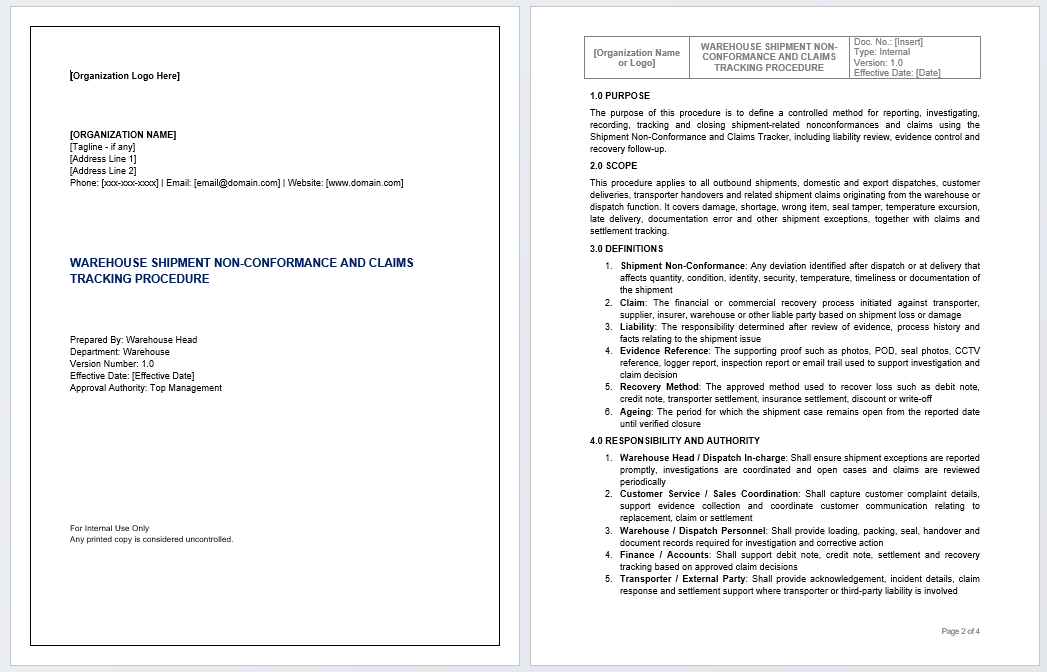
The above image is only a preview. This Warehouse Shipment Non-Conformance and Claims Tracking Procedure Template helps organizations standardize the reporting, investigation, tracking, and closure of shipment-related issues and claims. It is useful for warehouses, dispatch teams, logistics operations, and customer service functions that need stronger recovery control, evidence tracking, and corrective action follow-up.
Description
What is this Warehouse Shipment Non-Conformance and Claims Tracking Procedure Template?
The above image is only a preview. This Warehouse Shipment Non-Conformance and Claims Tracking Procedure Template helps organizations control shipment-related issues after dispatch or delivery. It defines how exceptions are reported, how evidence is captured, how liability is reviewed, and how claims are tracked to closure. Therefore, it supports better customer issue management and stronger recovery control.
Moreover, this template is designed for practical shipment incident handling. It covers damage, shortage, wrong item delivery, seal issues, late delivery, documentation error, temperature excursion, and related commercial or operational claims. As a result, it gives businesses a structured process for handling shipment failures instead of reacting case by case. In addition, it improves traceability across warehouse, dispatch, customer service, finance, and transporter interfaces.
Furthermore, the procedure is linked to the shipment non-conformance and claims tracker. Thus, users can connect the SOP with the actual tracking document used to log complaints, evidence, recovery route, settlement status, and ageing. Consequently, it becomes a working control tool rather than a formal file with no operational value.
Besides that, shipment failures often create both service risk and financial loss. When cases are handled late, evidence becomes weak and recovery becomes difficult. Hence, this template helps teams act faster, preserve proof, assign ownership, and monitor open cases until closure. That makes it useful for warehouses that want better discipline in post-dispatch issue handling.
Who can use this template?
This template is useful for warehouses, dispatch teams, logistics companies, transport-linked businesses, exporters, e-commerce operations, distribution centers, and manufacturing units that ship goods regularly. Similarly, it suits organizations that manage transporter claims, delivery complaints, insurance follow-up, or debit note and credit note actions. Therefore, it is relevant across many shipment-intensive operations.
Warehouse heads can use it to formalize shipment issue handling. Customer service teams can use it to capture complaints correctly. Dispatch teams can use it to support evidence review. Finance teams can use it to track claim recovery or settlement. Likewise, sales coordinators can use it when customer-facing follow-up is required.
In addition, this template is useful for internal audits, ISO documentation, claims review meetings, and process improvement work. Consultants, auditors, and business owners can also use it to strengthen post-dispatch governance. Therefore, it serves both operational control and management oversight.
Why is this template useful?
This template adds value because it deals with real shipment problems that generic SOPs often ignore. It helps structure evidence collection, incident logging, containment, liability review, claim route selection, recovery tracking, corrective action, and ageing review. As a result, businesses can reduce confusion and improve response quality.
Moreover, it supports stronger commercial protection. Cases involving transporter damage, shortage, wrong dispatch, or documentation lapse can become expensive when handled poorly. Therefore, a formal claims tracking process helps protect margin and improve recovery outcomes. Furthermore, it encourages teams to identify root causes rather than only close complaints quickly.
Additionally, the procedure improves visibility of open cases. It helps management review recurring issues, overdue claims, weak transport controls, and repeated dispatch errors. Consequently, the organization can take preventive action beyond individual settlements. Also, the editable format allows easy customization for workflow, claim ownership, and evidence references.
Most importantly, this template helps businesses treat shipment issues as controlled cases, not scattered emails or informal follow-ups. It supports discipline, accountability, and better financial follow-through. Therefore, it is a valuable document for warehouses that want a professional method for shipment non-conformance and claims tracking.


